



Laboratory of Immune Regulation

Laboratory of Immune Regulation

Seoul National University
Laboratory of Immune Regulation

Laboratory of Immune Regulation

Seoul National University
Laboratory of Immune Regulation

Laboratory of Immune Regulation

Seoul National University

Publications+ more

(2025) Human cytomegalovirus long non-coding RNA counteracts nuclear cGAS to facilitate immune evasion, Nature Microbiology
(2025) N6-methyladenosine modification of HCMV IE1 transcript promotes the repressive state of viral genome to achieve latent infection, PNAS
(2025) Human cytomegalovirus infection induces L1 expression through UL38-dependent mTOR-KAP1 pathway, PLoS ONE
(2024) Human cytomegalovirus harnesses host L1 retrotransposon for efficient replication. Nature Communications. 15:7640. *These authors contributed equally, Nature Communications.
(2024) Human immunodeficiency virus-1 induces and targets host genomic R-loops for viral genome integration., eLife
(2022) Functional and molecular dissection of HCMV long non-coding RNAs, Scientific Reports
(2021) [도서] 코로나 사이언스: 팬데믹에서 엔데믹으로, 동아시아
(2021) USP21 deubiquitinase regulates AIM2 inflammasome activation, The Journal of Immunology
(2021) STING facilitates nuclear import of herpesvirus genome during infection, PNAS
(2021) Aicardi-Goutières syndrome-associated gene SAMHD1 preserves genome integrity by preventing R-loop formation at transcription–replication conflict regions, PLOS Genetics

Welcome to the
"Laboratory of Immune Regulation"

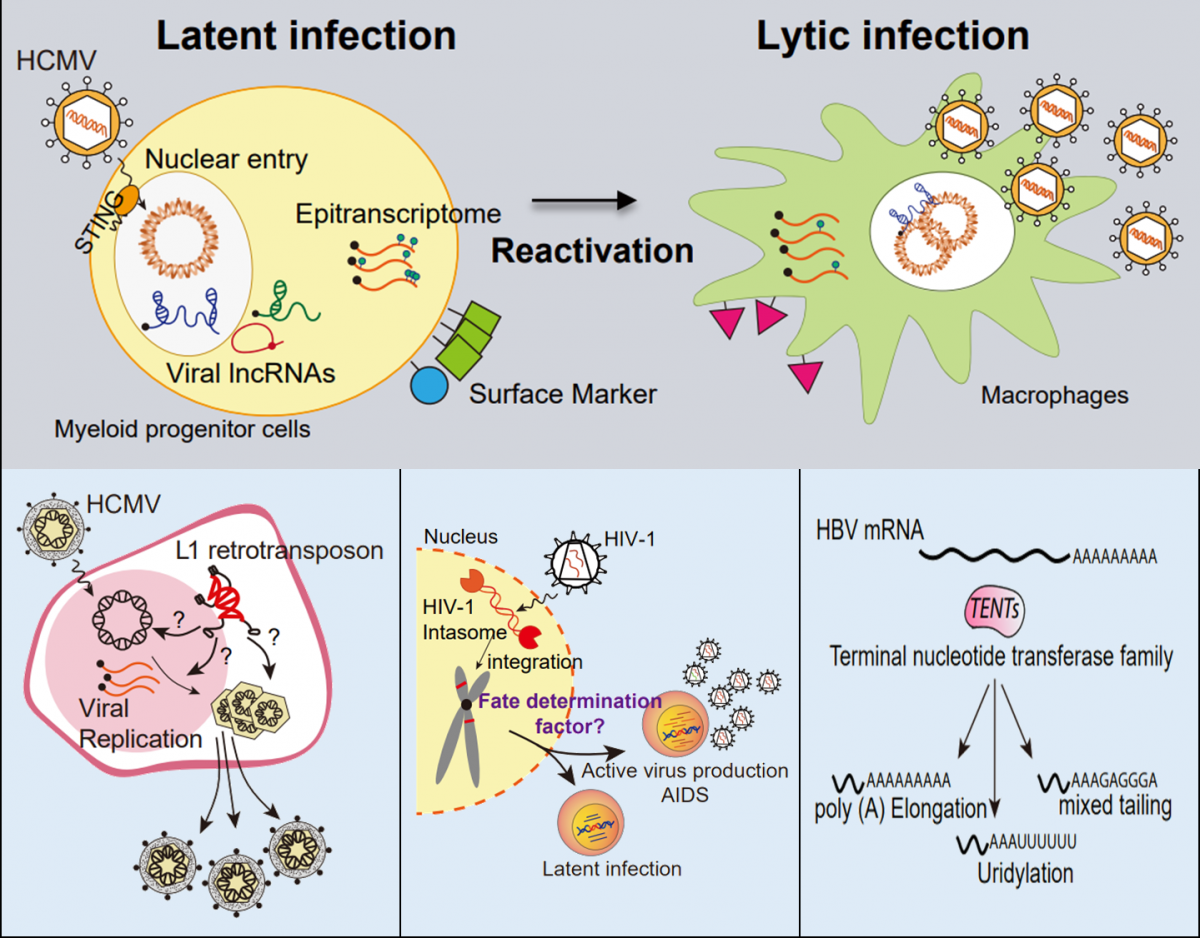
Host-virus interactions are complex processes that span binding to cells, entry, dissemination and finally lytic or latent infection. During infection, host innate immune system restricts viral replication. However, mechanisms underlying viral propagation out of the host surveillance remain unclear. Our research goal is to understand the molecular basis of virus latency
establishment and how it plays a critical role in cellular immune evasion and/or viral reactivation. In addition, we are interested in understanding the role of “the endogenous parasites”, retroelements in host-virus interaction and innate immunity.
Ongoing research projects include:
● HCMV nuclear entry and Latency establishment
● Discover the role of viral long non-coding RNAs in HCMV latency-reactivation.
● Epitranscriptomic features of HCMV latency-reactivation.
● Investigate therapeutic targets of HCMV latent-infected cells.
● Interaction between L1 retrotransposon and HCMV
● Landscape of HIV-1 latent infection integration sites
● RNA biology of Hepatitis B virus